


10 Years of Beyoncé's Lemonade
Ten years ago today, Lemonade was released to the world and shattered the musical persona that Beyoncé had cultivated from her early career. In a strikingly honest account of infidelity and betrayal, the singer’s venture into alchemising her pain into art reached its pinnacle. "Though I grew up around it, of course, it has taken me this decade-long period to get all the more closer". The Mic’s Daniela Roux reports.

The release of Lemonade is hazy in my mind. The music videos on my home computer. The vibrations coursing through the radio. Her visuals always felt emotive and visually-eloquent. So, sitting down ten years later, ten years older, to revisit this album feels like a stepping stone. Lemonade reminds me of the gravity of art’s purpose in our life.
Lemonade has certainly become solidified as a central album to the music world. Evidently, as of today, it is named Rolling Stone’s greatest album of the twenty-first-century.
From the opening moments, Pray You Catch Me strips back everything. Beyoncé does not tumble in as an artist, performer, or even alter ego. Simply, she exposes the wounds of betrayal through a breathy vibrato. Her tone is antithetical to the power-house vocalist she has solidified herself as, and she’s unrecognisable. The simple reverberations and stark absence of any vocal catharsis leaves a craving for resolution. Sonically, the world leaves a wound open, and there’s a poignantly loosened grip on control. This idea is only affirmed by the visual album.
In the music video, Beyoncé sings in front of a red curtain wearing a black hoodie and minimal makeup. As she whimpers, glaring at the skyline of the city, she steps off the building's ledge, and the album quickly shifts into its next chapter. The visual album is a reminder that Lemonade will not be a comfortable listening experience.
Intuition, denial, and the performance of femininity:
The transition to Hold Up emphasises the importance of the visual in music. Singularly, Hold Up does not immediately signify anger. It is soft and Reggae-inflicted and, at points, almost soothes the listener. The calm before the storm. The moment when one cracks a smile or little laugh before releasing the rage.
In the visual album, as the door opens to allow the water to rush down the stairs, the song becomes something else entirely. It is both the music video and spoken poem before the song that shapes the way in which it was intended to impact listeners.
In her poem, Beyoncé accounts all of the ways in which she tried to shrink herself, to be softer, more desirable, more palatable. It is precisely this context which defines Hold Up.
For the rest of the video, she smiles as she glides through the street in that iconic, yellow dress. Laughing with each crash. Smashing cars, while onlookers dance or appear bemused. There is an interesting commentary on the concept of entertainment in this video. A refrain used in this song is “they.” Who are they? The other women, the voyeurs, the industry?

My interpretation of Hold Up and its commentary on the performance of femininity became elevated through my interaction with bell hooks. Succinctly, hooks deduces that “the goddess-like character of Beyoncé is sexualised along with her acts of emotional violence” one that she poignantly concludes is just “pure fantasy”. I found myself re-evaluating the presentation of resistance, or anger, being portrayed in the video.
The containment, sexuality, and control are still all emblematic of an androccentric view of angry women. Is Hold Up Beyoncé’s satirical construct of women’s rage from a male perspective?
Despite hooks's layered and intentional review of Lemonade, which you should certainly read alongside revisiting Lemonade, I do believe that within the context of the entire album, Hold Up is supposed to be a ‘fantasy’. It is supposed to make anger, especially in women, appear idealised. This is precisely what enables the unfiltered emotion in the next track to flourish.
Anger as rupture:
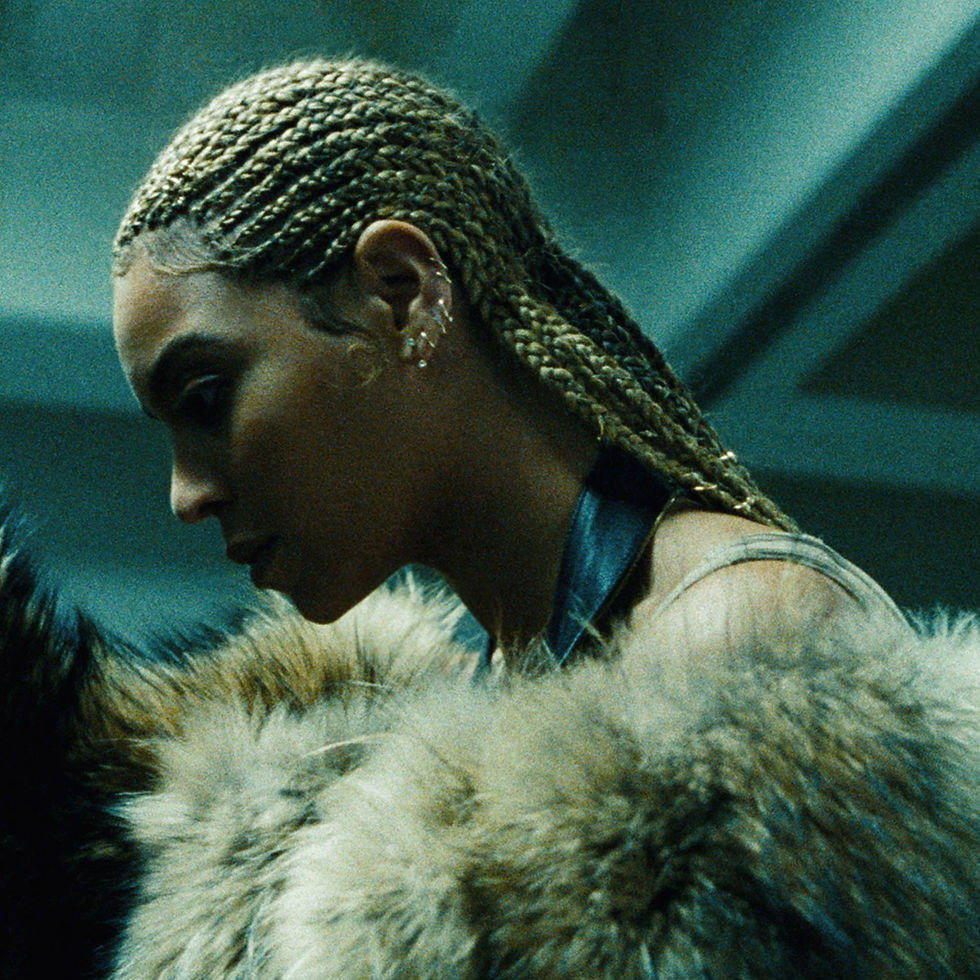
Where Hold Up is limitation, Don’t Hurt Yourself becomes suffocation. This track, featuring Jack White and sampling Led Zeppelin’s When the Levee Breaks, serves as its predecessor’s necessary antonym. Or sequel, depending on your interpretation.
The production and vocal elements introduce a sound that is not synonymous with Beyoncé or her 'brand'. In creating a viciously confronting rock song, Beyoncé de-centres her pristinely pop-acclaimed reputation.

Upon initial listen, Don’t Hurt Yourself can be perceived as a stand-alone catharsis of betrayal. Yet, it is the visual element which elevates the didactic messages within the entire album. Evidently, as an interlude between this track and the next, Beyoncé quotes Malcolm X:
“The most disrespected person in America is the Black woman. The most unprotected person in America is the Black woman.The most neglected person in America is the Black woman.”
The inclusion of Malcolm X’s culturally-permeating, and still greatly relevant, speech, Who Taught You to Hate Yourself?, emphasises the faces of the Black women in her visual album’s montage. hooks notes that the visual album propagates “the construction of a powerfully symbolic Black female sisterhood that resists invisibility”. This layer of political context shifts what began as an introspective track into a culturally-reflective one. Don’t Hurt Yourself becomes much larger than Beyoncé’s feelings alone. The presentation of anger was no longer confined to a relationship. It was historically representative of the Black women failed by America. Overall, this track marks the thematic prevalence of sisterhood. Unity becomes a leitmotif that is both emulated in lyricism and visual elements.
Apathy and the illusion of detachment:
Sorry certainly cements the bond of sisterhood as its foundation. Lyrically, this song reads as empowering. Whether it be her allusions to, “Me and my ladies” or “Me and my whoadies”, Beyoncé packs the song full of dialectical lyrics which celebrate female friendship through the lens of her culture.
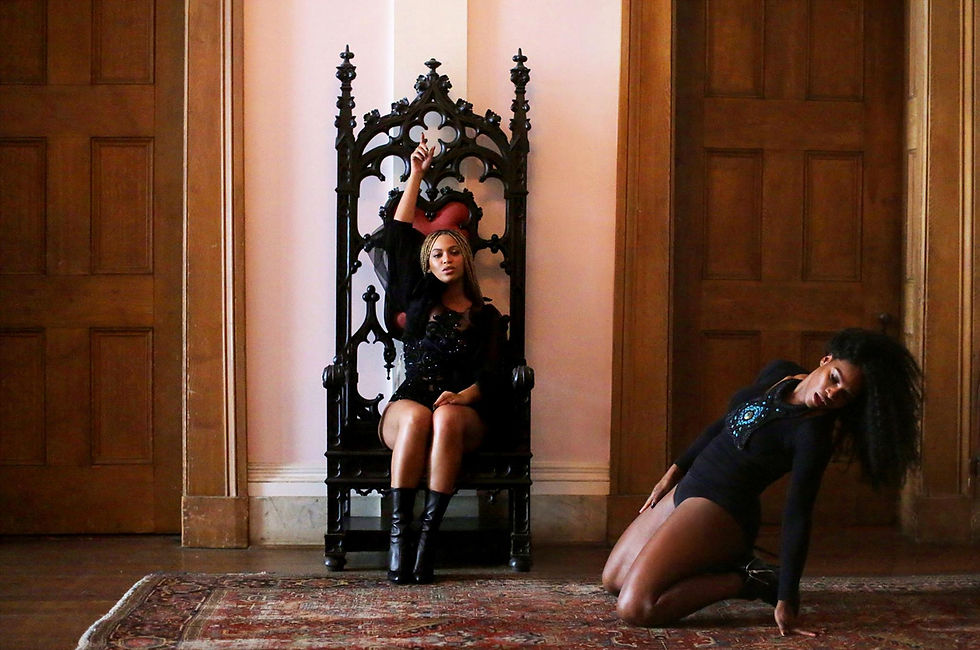
The visual album centres Serena Williams as the star of the music video, enabling her to exist in a multifaceted, playful way that is seperable from the image she’s attached to. Additionally, there are frequent cuts to women dancing, flipping of the camera, and, simply, having fun. However, as the track progresses, I couldn’t help but feel that Sorry exudes apathy as opposed to empowerment. There is a tension between faux-flippancy and the guise of its anthem-like qualities, such as the production and vocal tone. The detachment presented reads as a performance.
This interpretation became central to how the next track, 6 Inch, was framed. This track embodies the idea of empowerment through a more sensual tone. This is exemplified in Beyoncé’s decision to include The Weeknd as a feature.
In the creation of this song, producers Danny Boy Styles, Ben Billions, Boots, and Beyoncé sampled Animal Collective's psych-folk titled My Girls. In addition to this, the song finds its roots in the claim of Hip-Hop, sampling Isaac Hayes’s cover of Dionne Warwick’s Walk on By. Sonically, the track presents a unique vocal version of Beyoncé and a cacophony of inspired sounds. Her pitch drops to a rare calibre that fluctuates constantly from verse to chorus. Overall, making for a paradoxical performance.
Interestingly, the visuals resist the archetypically male-gaze performance that can be seen in her past music videos. Just the mere notion of an elusive “she” ruling the narrative of the song, with no directly explicit lyrics, positions it from a perspective of female eroticism. In viewing this song, it was my interaction with Audre Lorde’s essay that elevated my interpretation.
Lorde defines the erotic as existing on a “deeply female and spiritual plane”, and so the sensuality that can be typically feminine rejects the dominantly aesthetic-based presentation propagated by the media. Lorde argues that it is “fashionable to separate the spiritual [...] from the political” and so eroticism is often framed from the perspective of sensation absent of meaning. Lorde believes in re-centering eroticism in a way “which is female and self-affirming in the face of a racist, patriarchal, and anti-erotic society”.
Thereby, in revisiting 6 Inch, the narrative which focuses on power and ambition adhered at times to Lorde’s sentiment. Though one could certainly make a case against the song’s glorification of money – a general qualm with the album that I will explore at the end – it’s clear that the track is nonetheless Beyoncé-centred. Not male-centred. 6 Inch rejects objectification through the narrative format Beyoncé incorporates. 6 Inch reframes desirability as an imperative act of resilience against the undeniable de-valuation of intimacy when facing betrayals such as infidelity.

The video embraces this narrative, as the blurring of male faces decentres them from her experience. Furthermore the imagery, such as dark rooms and dilapidated walls, comes across as disorienting. 6 Inch underscores voyeurism in its embrace of decay. Through this lingering idea, we see the performance of apathy mascaraded as empowerment turned on its head.
Inheritance and the South:
Much like Don’t Hurt Yourself, Daddy Lessons becomes another genre-defining moment within the album. This is particularly relevant when we consider Beyoncé’s AOTY win for a country album. Thematically, this song elucidates a grapple with power structures.
The narrative of the song focuses on childhood and generational cycles. She begins to outline a father who wasn’t “always right” but who made her a “soldier.” She describes him as the “men like you”. Thereby, the tone of the song, like Don’t Hurt Yourself, begins to widen the scope of betrayal to the structurally prevalent ways in which mistreatment reproduces itself.

The music video only includes two consistent shots of Beyoncé: one with her riding on a horse, another of her singing the song in a tunnel. The rest of the video includes montages of young daughters with their fathers – including a video of Beyoncé’s own, Matthew Knowles.
"The anger was no longer confined to a relationship. It was historically representative of the Black women failed by America."
The song clearly becomes a commentary on how when patterns are left neglected, they tend to repeat themselves. The visual symbolism and engagement with Southern imagery becomes an allegory for the deeply-loaded history which governs the existence of Black families in America.
As exemplified by Joshua Jackson, the visual prevalence of the antebellum South is underscored greatly with a portrayal not congruent with how it “is historically portrayed in popular film and television”. Rather, all visual allusions to the South depict a “utopian future, where African Americans are finally upheld as the people who built [...] postbellum United States”.
This is particularly salient when we consider the treatment of Daddy Lessons upon its release. As Billboard notes, despite being submitted to win a Grammy in the country genre, it was rejected by the committee. Cowboy Carter, released eight years later, received a comparable level of backlash for not inhibiting enough country genre elements. In a brief note by Holley, it has often been agreed upon that the allegedly “First Family of Country Music” were heavily inspired by the playing style of Lesley Riddle, a Black blues and gospel guitarist. Thus, the impact of Black culture within American country music is unprecedented.
Overall, ,Daddy Lessons inhibits the confrontation of her family lineage. In questioning the perpetuation of cyclical mistreatment through generational trauma, with that, comes another layer which confronts institutional suppressions still prevalent throughout the United States today.
The liminal, and actual, space of healing:
Love Drought embodies suspension. It was also the first time in the album where we feel balanced. The motif of water flows throughout the song, and unlike its presentation in Hold Up, it is no longer destructive. It is cleansing. The song itself has an instrumental that encapsulates what it feels like to stand underneath a waterfall. The lyrics embedded reflect forgiveness and rebuilding. The triad of optimism is only accompanied by the tone of smoothness she embraces: “you and me could calm a war down”, “you and me could make it rain now”, “you and me could stop this love drought.”

In the visual album, the women in white dresses, balancing each other with rope, reflect the idea of equilibrium. The flowers are in bloom and the water sits timidly as the sun makes its way on the horizon. This song illustrates that healing is being attempted. Once again, re-affirming the point that the journey to empowerment is not linear.
The following track, Sandcastles, plunges into feelings of despair. The decision to produce an unbearably stripped piano melody re-centres feelings of peace into a panging grief. The song only features Beyoncé, her keys, and archetypal ballad conventions. It is the simplicity of this song which makes it so poignant. Due to the production, the moment in which Beyoncé’s voice cracks as she recounts her partner’s “face”, impacts us twice as hard. The conscious decision to not cover up vocal imperfections in the entirety of this album serves as a mechanism to centre humanity. She continues to reject any notion of perfection or covering up.
In the visual album, when her partner appears, his presence made the narrative more concrete but it also risked pulling focus away from her experience. I realised starkly:
Lemonade is not really about him. It is about what it feels like to be her. It is about all of the women this album represents.
The personal becomes political:
As an interlude, Forward is emblematic of this translation from the personal to the political. Its somber and minimalistic production unearths the lullaby-like tone that guides us through the song. The piano-driven melody encapsulates the emotional intimacy that prepares us for the historical importance of the next track.

Freedom, sequenced after Forward, quickly widens the lens from her personal grief to the grief of the world – as has been consistent throughout the album thus far. Before understanding the undeniable political prominence of Freedom, it is imperative to look into the song’s structure. As noted by Horowitz, the organs are sourced in the late 1960s, sampled from band Kaleidoscope. Additionally, the track also incorporates Alan Lomax's 1959 field recordings at Memphis' Great Harvest Missionary Baptist Church. Literally in its fibre, the track is an integration of culture and time. Lyrically, the decision to include Kendrick Lamar as the feature affirms this, as a rapper acclaimed for his ability to translate his personal experiences into political and rebellious art.
In the visual album, Love Drought’s music video transitions into a tribute to the Black Lives Matter movement. Freedom integrates every single introspectively explored emotion thus far – grief, anger, resilience – and places them within a broader societal context. Beyoncé utilises her art to platform the grief of those who have lost their loved ones to police brutality.
Resolution and lineage:
The next track is Lemonade’s true conclusion. In the visual album, a vital speech gives context for the decision-making process to name the entire album. Before delving into the significance of this song, and the beautiful irony that as we approach Lemonade’s ten-year anniversary, it is finally receiving its flowers, let us understand its meaning.
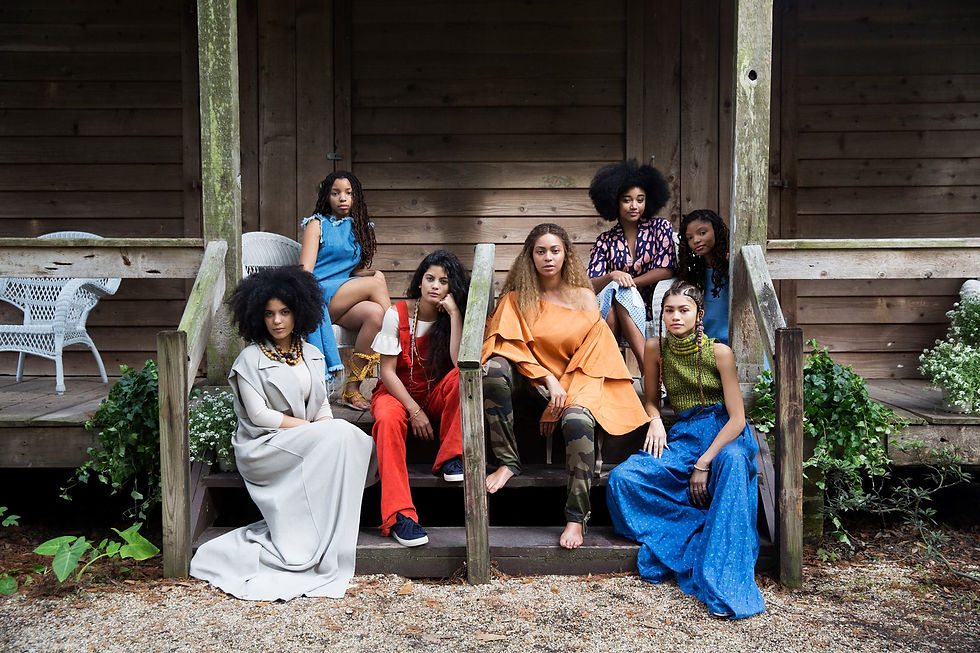
In the visual album, there is a sequence which illustrates her partner's grandmother, Hattie. She recites the quote “I was served lemons, but I made lemonade,” bringing the album title’s meaning to life. This quote is further elevated by Beyoncé’s poem:
My grandma said “nothing real can be threatened
True love brought salvation back into me
With every tear came redemption
And my torturer became my remedy
So we're gonna heal, we're gonna start again
You've brought the orchestra
Synchronised swimmers, you are the magician
Pull me back together again the way you cut me in half
Make the woman in doubt disappear
Pull the sorrow from between my legs like silk,
Knot after knot after knot
The audience applauds
But we can't hear them.
And with that, All Night erupts into its groundbreakingly beautiful introduction.
In the visual album, we return to the field that a stripped-back Beyoncé walked through mouthing Pray You Catch Me. This time, she can be seen wearing the same traditional outfit that we saw in Daddy Lessons. On a political level, Jackson notes that All Night “presents us with an afro-futurist revision of Blackness in the US South”, and this becomes an imperative interpretation when we consider the lyrical content of the song.
This song is titled underneath the chapter of ‘Reformation’, and every aspect of it centres on rebuilding. Rebuilding love, lineage and culture. All Night embraces sensuality in a more grounded way than 6 Inch. All Night portrays healing in a more concluded manner than Love Drought.
Lyrically, the song devotes itself to humanity. There is a promise to “trade your broken wings for mine” and “sweet love all night long.” And with that, her intimacy is reclaimed. All of the feelings that she grappled with in the culmination to this point are redeemed.
Alongside the important imagery of the field, Beyoncé includes montages of people in love. A mutlicultural, diverse group of sexualities, and loves from platonic to familial to romantic are all depicted.
As the song concludes, it reads the title in a stark white font: ‘Lemonade.’

The end of an era?
Now, you may be wondering, what about Formation? As illustrated by Beyoncé herself, All Night is the true conclusion of Lemonade. This raises an important question as to why she would include it on the album in both physical and digital form. Well, Formation is what makes Lemonade as didactic as it is.
Formation is the true empowerment that Sorry grappled with early on in the album. In Formation, Beyoncé is inhibiting a version of herself that is no longer a performance. Yet, also no longer defined by her pain. Formation is the intersection of her alter ego with the starkly real pain that she experienced as a woman. She comes into herself in a way which has defined her music in the decade since Lemonade’s release.
Visually, according to Jackson, the song aligns with the rest of the album in the way that it incorporates “a southern gothic mishmash of postbellum Southern symbols like New Orleans after Hurricane Katrina”, ensuring that the track is as equally embedded in political diatribe as the rest of the album.
The album’s end really signifies a beginning, a tone of rebirth. Formation is indicative of the Beyoncé we know today. Her fearless confrontation, distinct tone, and experimentalism alike.
Is the album perfect?
No. Lemonade is and will forever be a cultural artefact. Any piece of textually-historicist art will complexly reflect the era it was created in, both the good and the ugly. Succinctly, hooks concluded that its visual album was “the business of capitalist money-making at its best.” She noted that, “In this fictive world [...] it does not bring exploitation and domination to an end”. Furthermore, Rolling Stone have also raised “valid concerns [...] as to whether she actually lives out the values of the social iconography she’s channeled or fundamentally contradicts them”.
As mentioned earlier, there are clearly capitalist symbols within the album. Allusions to materialism and consumerism all raise valid concerns about the era in which it was made. One which, at times, could fundamentally position individuality over love of one another – a sentiment that seemed so antithetical to Lemonade’s overarching message.
Ten Years Later:
Revisiting Lemonade has elucidated that it is impossible to reduce this album to a single narrative. It is an album about infidelity. It is an album about Black womanhood. It is an album about generational trauma. It is an album about America. It refuses to separate those things, instead, it insists that they exist simultaneously.
In each decade that passes, the album will be perceived in a new light, with arising ideas. More importantly, with the passing years, it will re-teach us something about humanity. I am grateful that upon this first decade, I was able to review the masterful album which is: Lemonade.
References:
Beyoncé (2016) Lemonade (visual album). Tidal. Available at: https://tidal.com/video/108046194 (Accessed: 19 April 2026).
Billboard (2016) Beyoncé’s “Daddy Lessons” Rejected by Grammy Country Committee. Available at: https://www.billboard.com/music/awards/beyonce-daddy-lessons-rejected-grammy-country-committee-7604485/ (Accessed: 19 April 2026).
Cragg, M. (2020) Diana Gordon: the secret ingredient in Beyoncé’s Lemonade. The Guardian. Available at: https://www.theguardian.com/music/2020/apr/25/diana-gordon-the-secret-ingredient-in-beyonces-lemonade (Accessed: 19 April 2026).
Davis, R. (2020) Still Wondering Why Beyoncé Named Her New Album “Lemonade”? Here’s Your Answer. Essence. Available at: https://www.essence.com/news/still-wondering-why-beyonce-named-her-new-album-lemonade-heres-your-answer/ (Accessed: 19 April 2026).
Ford, E. and Scofield, R. (2024) Beyoncé Backlash Is Part of a Century of Cowboy Gatekeeping. TIME. Available at: https://time.com/6965367/cowboy-carter-black-country-history/ (Accessed: 19 April 2026).
Garcia, P. (2016) Deconstructing Lemonade: Everything You Need to Know About Beyoncé’s New Visual Album. Vogue. Available at: https://www.vogue.com/article/deconstructing-beyonce-lemonade (Accessed: 19 April 2026).
Genius (2016) “Redemption (Lemonade Poem, Part 11)”. Available at: https://genius.com/Beyonce-redemption-lemonade-poem-part-11-annotated (Accessed: 19 April 2026).
Genius (2016) “Sorry” – Beyoncé lyrics. Available at: https://genius.com/Beyonce-sorry-lyrics (Accessed: 19 April 2026).
Holley, S.E. (2025) Beyoncé’s Cowboy Carter tour reminds us that Black artists are at the roots of country music. National Geographic. Available at: https://www.nationalgeographic.com/history/article/black-history-in-country-music (Accessed: 19 April 2026).
hooks, b. (2016) Beyoncé’s Lemonade is capitalist money-making at its best. The Guardian. Available at: https://www.theguardian.com/music/2016/may/11/capitalism-of-beyonce-lemonade-album (Accessed: 19 April 2026).
Horowitz, S.J. (2016) Breaking Down Beyoncé’s Lemonade Samples. Pitchfork. Available at: https://pitchfork.com/thepitch/1116-breaking-down-beyonces-lemonade-samples/ (Accessed: 19 April 2026).
Jackson, J. (2017) Beyoncé’s Lemonade: Redeeming Antebellum Imagery with an Afro-futurist Postbellum Imaginary. MediaCommons. Available at: https://mediacommons.org/imr/2017/10/08/beyonc-s-lemonade-redeeming-antebellum-imagery-afrofuturist-postbellum-imaginary (Accessed: 19 April 2026).
Lorde, A. (1984) ‘Uses of the Erotic: The Erotic as Power’, in Sister Outsider: Essays and Speeches. Trumansburg, NY: Crossing Press.
Malcolm X (1962) Who Taught You to Hate Yourself? Available at: https://genius.com/Malcolm-x-who-taught-you-to-hate-yourself-annotated (Accessed: 19 April 2026).
Rolling Stone (2025) The 250 Greatest Albums of the 21st Century So Far. Available at: https://www.rollingstone.com/music/music-lists/best-albums-21st-century-1235177256/ (Accessed: 19 April 2026).
Strauss, M. (2016) Beyoncé’s Lemonade collaborator MeLo-X gives first interview on making of the album. Pitchfork. Available at: https://pitchfork.com/news/65045-beyonces-lemonade-collaborator-melo-x-gives-first-interview-on-making-of-the-album/ (Accessed: 19 April 2026).
Edited by Daniela Roux


Comments