


Interview: Gina Birch (The Raincoats)
A true trailblazer and master of many crafts, the artist and filmmaker Gina Birch is a woman who lives life on her own terms. As a founding member of a true "Favourite Band's Favourite Band," The Raincoats, she paved the way along with the likes of The Slits for a female and feminist voice to become commonplace in punk. Today, she releases equally boundary and button-pushing solo music, and was recently the face of the seminal Women in Revolt! exhibition which toured London, Edinburgh and Manchester last year. I sat down with Gina to discuss art, feminism, the London squat origins of punk, and, of course, her childhood here in Nottingham...
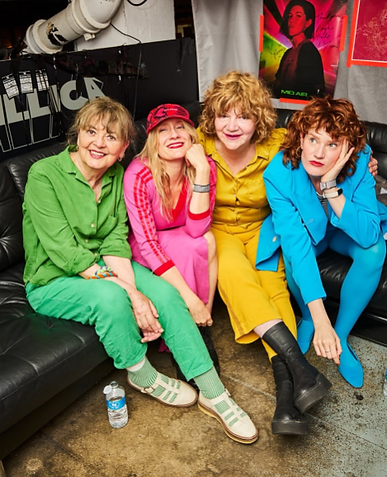
You were born in Nottingham and lived here until you went to London for art school. Were you involved in music or culture growing up at all?
I mean, I had the odd record here and there and listened to albums, but not really other than that. I didn’t really go out for it beyond that, girls didn’t really play in bands then, I think I saw The Small Faces at a place called The Slipper though and a few different people in different places but not that much. No, I was interested in the counter-culture, but more like taking speed and things like that! It seemed very dead at the time. We went to pubs, Yates' was one of them, and sometimes there’d be a trio playing a violin, bass, and piano. We’d all have our port and lemon and just get off our heads listening to that really.
Did you find that anything was unique about your upbringing for being in Nottingham?
Market Square, the Council House, and the two lions were where we always met. Until the shopping centres arrived like Victoria Centre and Broadmarsh - god knows what’s there now - those were the places to meet. And behind the Council House there used to be a market. My parents would leave us in the car parked outside and run in and do the Saturday shopping, and, you know, it’s just very different now. The Playhouse was cool, I remember really liking it there: it was a good place to hang out, and really one of the only places you could feel the mix of drugs and of slightly upper culture. The culture there was a little bit more funky but a little more highbrow. And of course, the fact that Robin Hood was there was always a big thing. I think [the Robin Hood statue’s] bows and arrows were always being stolen! But it was just where I lived mostly: I don’t think I went on an aeroplane until I was 13, and then it was just to Germany on a school trip. So it was just where things happened for me, and in the Summer the nearest I got to water was the sprinklers in Market Square!
And then, when you moved to London, what did it feel like changed?
I mean, in Nottingham, you know where everything is and who your friends are. You could go into a few pubs on a night out and run into your mates. Whereas in London, you could be in the same city as everyone for your life, and never bump into them! That was really hard when I came to London, because I felt quite provincial and not quite as sophisticated next to people who’d grown up here. You know, they all drank black coffee and smoked different types of cigarettes, and their parents might be diplomats or something like that… Never realised how many people regularly go skiing!
But then, of course, you met the other founding members of The Raincoats at your art school. Did you initially connect over an interest in music or something else?
So, I’ll tell a bit of a story for this one. Before I came to London, I had studied an art foundation at what’s now Nottingham Trent University, it was Trent Polytechnic back then. And I met a good friend there, and we used to hitchhike around: you could hitchhike in those days - a few people got murdered but we didn’t hear about it! But anyway, we ended up at Saint Martin’s in London once, with a friend of ours, and it turned out they were headed to see a band called the Sex Pistols…
No way!
I know, it was a bit strange! It was their first gig, and they played about five songs before the plug was pulled on them apparently! But my friend Alex and I were like “They were brilliant”, before getting back to Nottingham and realising we’d been derisively labelled as Sex Pistols fans! Then we came back down to London the following September, September 1976, and I already knew a little bit about punk, and ended up moving into a squat, which you had to do in those days. So much of London was kind of abandoned, so squatting was quite easy and developed quite a culture - a boy in my year said he had room in his squat, and I ended up living there. It was in Queensway, near Notting Hill, and it was basically just a little cul-de-sac full of artists and artisans. So I moved in there, and Richard Dudanski who’d been in the 101ers with Joe Strummer [of The Clash] lived there with his wife, whose sister Palmolive started The Slits! So I just, I guess I landed in the middle of it. By accident, by design, I don’t know.

But when I met Ana [da Silva, founding member of the raincoats alongside Gina], we were both going to the Roxy club every night which was where all the new bands were playing: pretty sure I saw Siouxsie and the Banshees’ second ever gig or something there. But I liked it there because it reminded me of the hangouts in Nottingham: I could go there and see the same people. But Ana was a little older than me and could play a few chords, but it wasn’t until we saw The Slits who were an all-girl band that we thought you know, we could do that! We could be in that band!
Normally, if you saw a girl in the band, it was just the singer. But when we saw Palmolive on drums, it was Tessa [Pollitt] at that time on bass, and Ari Up singing, suddenly a switch flipped in our head that it was possible! It was so strange because when I woke up that morning, I wouldn’t have dreamed of being in a band, but from that moment, I really wanted to be in a band. That shift was just phenomenal, and earth shattering really. But I didn’t actually buy a guitar for a couple of months, and I couldn’t play anything at that time. I liked singing, but it wasn’t like I was having siiinging lessonssss either… which, I later discovered most people in bands had been those sorts of people.
And that hasn’t changed…
No, definitely not. However, at this time, of course we were all art students, and all of the walls were being torn down within the art schools. You could travel across departments and say, “I want to paint a painting,” “I want to make a film,” and then just do these things with a lot of freedom to experiment. And we weren’t well off, we were living off fresh air to be honest, but we also got the student grants, which I’m very sad to say your generation isn’t getting.
Tell me about it, I’ve got tons of debt to look forward to instead!
Yep, it’s terrible, terrible what they’re doing, I’m on the frontlines about it. I think they should take the interest from my savings account and invest it in that student debt you all have now instead to be honest. But yeah, we had the grants, but still had to live off very little, I mean we didn’t have to pay rent as we were living in a squat, but we still had to pay for our art supplies, transport fares, and… well, drink.
But, to go back to my main point, Ana and I started playing music together, and initially there were two men in the group as well. Ana, being older than me, thought all things should be equal, whilst I was quite keen on the all-female thing. Then those two left, and we ended up joined by Palmolive, and also by Vicky who was very musical, she was a classically trained violinist who kind of had to come down to our level! But we liked the weird screeches and squeaks, they made it raw and interesting. But in short, we all just met through being out and about, at that time it was so easy to find people who might be interested in what you were doing. And the thing with punk, in the early days at least, you could tell who was a punk from what they wore, because we always looked a bit scruffier and always bought things in charity shops, particularly those skin-tight jeans and creeper shoes. We were kind of just your typical lower-middle-class art students underneath it all though!

I wish I was at my parents’ house right now, because of course your face was the face of the Women in Revolt! exhibition which toured the UK last year, and I have that exact poster (see above) on my wall! How did you feel more broadly about how that exhibition turned out?
It was such a great exhibition, and what stood out to me in particular was that there always seemed to be a dialogue happening. I went to the opening of the exhibition in every city, and there were so many women, and even some men, having so many open conversations about what was happening, creativity, and where the works that were showcased had been and where they came from - it really inspired discussion. It feels like they should always have a room at a large museum which features art made by women, and where women can go and have a natter about their creativity, because it was so powerful.
How did it come to be your screaming face that was used? It’s a really powerful, evocative image.

When I was doing my fine art degree in London, like I say it was very no-walls, anything-goes. Derek Jarman had come to the college to show his super 8 films, and again I had a bit of an epiphany that suddenly I wanted to try making some super 8 films of my own. I made all sorts, but one thing I really wanted to try was process art - that was a thing at this time where you’d produce a work which was just you doing the same thing over and over again, I suppose it’s a bit Warhol-esque. But you did the same thing for the duration of time you had. A super 8 cartridge lasted 3 minutes, so I decided I was going to scream for the duration of the three minutes. Well, I thought I’d be able to scream consistently for the duration of the three minutes, but I didn’t exactly practice - so it ended up being more a series of shorter screams!
So I’d made this thing, and I kind of then stuck it in my pocket and never showed it to anyone at the time. But then later, when Ana and I were doing some stuff for The Raincoats, we got out some of our old films: I’d made some other films where I jumped through giant paper screens and things, and because I’d been making music videos, I could edit these things together, and kind of spliced the scream and lots of other things into one. And this guy called Joe Scotland, who ran a place called Studio Voltaire down in Clapham, was sharing a flat with a woman who wanted to curate an exhibition of women’s art from between 1970 and 1990. And I could tell Joe was really interested in this film, his eyes kind of lit up when he saw it. Later, I hear back from the curator of what would become Women in Revolt, and she wants to show the three-minute scream: and then, I start getting loads of emails from people in the institution asking for higher resolution because she wants to project it not on a monitor at the back of a gallery, but three metres wide! So I got it re-scanned: you can’t get more out of a tiny super 8 than is there but it turned out well.
Then, about a week later, I get asked again if they can use a still from the film for the poster and for promotion! And then, I start seeing it everywhere: on the tube there is just poster, poster, poster, poster, all with my face on it!
It must have been such an incredible thing to be involved with: I went to see the exhibition on a whim on the recommendation of a friend when I was staying in Manchester for a gig, and I honestly ended up on the verge of tears from it: like you talk a lot about, so much of it is about women realising they can create on their own terms.
Yes, absolutely, and I ended up meeting so many women who were about ten or so years older than me who had been involved in women’s consciousness raising groups in the early 70s and things like that! I found it interesting because at the time of punk, feminism was seen as a dirty word, which I always thought was a male conspiracy. But there were so many interesting developments regarding women in the early 1970s - a group of women protested the 1970 Miss World competition, on account of it being seen to exploit women and reduce them to their looks. However, that was also the first year that Black women from Africa were competing, which produced an interesting dilemma and conversation! There was a documentary and a drama made about this, you should look them up.
On that kind of note, did you consider The Raincoats to be a feminist band?
Not in the very early days, though when Palmolive came into the fold I guess she bought some of the politics with her. We were always asked about this in interviews, but we weren’t particularly ranty about it: when somebody like Kathleen Hanna from Bikini Kill later came about, she would give amazing information about wages and political speech, but we weren’t quite there yet - we were just finding our feet. A lot of our songs were about [women] standing on our own two feet, but I think there were stepping stones: Vicky had a song about a soldier getting off a rape case because he was in the army, for instance, so politics did influence pieces of what we did.

And then, we get to the present, with your most recent solo album Trouble, which has a very unique and psychedelic sound. What were you listening to at the time of writing and recording this album?
My husband says that I don’t tend to listen to loads of different music, I was just putting basslines together on my computer and putting little pieces together as I went along - little ideas just popped into my head over time. It was all mostly just about basslines and developing ideas: Cello Song came from me painting a picture: at first it was about, funnily enough, the 1970 Miss World competition, then maybe it was about Sylvia Plath, then Marilyn Monroe, then Kurt Cobain! So eventually, you’re not quite sure as to where it came from and, particularly when [it’s a solo record], you just end up having a dialogue with yourself. With a solo record, in particular, it’s interesting because it’s almost more like being a visual artist again as you make the work on your own! On my other record, I Play My Bass Loud, a lot of that was also conversations in my own head that developed over time into songs: phrases like I Will Never Wear Stilletoes! And then perhaps I’d put the tune up six months later.
Gina Birch plays the Nottingham Metronome on February 27th, in support of Au Pairs. Her album Trouble is out now via Rough Trade Records.
Liz Clarke
Edited by Liz Clarke
Photographs 1, 3, and 4 provided directly courtesy of Gina Birch
Photograph 2 sourced from Gina Birch on Instagram (@gina.birch)
Photograph 5 (album art) provided courtesy of Rough Trade Records


Comments