


A Review @ Hockley Hustle
Updated: Feb 7
Hockley Hustle returned this year with a line-up like no other. Creating a parallel universe in which each person could handcraft their own musical world for the day. As a newcomer to gigs, this festival was a masterful introduction. The diverse array of genres, electrifying performances, and salt–of-the-earth artists. The Mic’s Daniela Roux reports.
Pretty Windows, The Angel Microbrewery:

My committee and I took a leisurely walk to The Angel Microbrewery, desperate to escape the light patter of rain inflating our freshly washed hair. We stood outside the pub, eager to stand in the warmth of wooden beams and swaying bodies, away from the winter chill. As we entered, the pub had this cozy feeling, with families, couples, and friends all beginning to cluster around the speakers. Pretty Windows entered. The lead singer quipped jokes and self deprecatingly commented on ‘day drinking.’ They were invested, yet relaxed. The lead singer had a habit of tapping his foot and twirling the mic, seen when singing hits such as Zimmerman Standing. The audience enjoyed pints, the musicians enjoyed the crowd, and I loved it all. This band was electric, from the spoken poetics to the nonchalance of the guitarist. Two men. Two mates. They have a knack for connection, and distraction on their minds. There was a vulnerability that can only be experienced live. I must admit, the second I got home, I added their hit song (No Wonder They Invented) The Monday Club to my sulkiest playlist.
Build Beats UK, Pogo Nottingham:

After the intoxicating performance, my committee and I were intent on heading to something more hands on. So, we headed to Pogo, where an interactive DJ workshop was being held. As you enter Pogo, you are gently ushered upstairs to a forest green room. Each table had a DJ set. In each booth sat two people: the amateur and the teacher. As someone hopeless with DJing, I was more intrigued to understand the motivation behind such a workshop. It seems so obvious, but we never really question teachers about why they’d want to teach. Courtesy to the organisers of Build Beats UK:
Q: Tell us a bit about what you're representing. An introduction.
A: So we're Build Beats, we're an in-person and online community who helps inspire music producers to share their music. We do in-person events, MIM studios, movers and we also do stuff at Stealth. It gives an opportunity for people to share their music and also for the people who are looking to find a way into it.
Q: What are the processes you guys follow to make sure people who are just starting off can feel comfortable to share?
A: That's a really good question. We started out by teaching. In the end, the people who are intermediate were struggling too. I always believe that you've got to fail to get anything done, especially making music. If you have no experience just come on, ask some questions, and watch people who have produced music for many years. Especially in today's day and age where it's so easy to get lost in the media landscape because there's just so much art out there. I just believe that especially when you're new, having an informal comfortable space, safe space to share your music, share your art, that's the best way to do it really.
Q: What's the stark advice for somebody who is just thinking of getting into it but doesn't know where to start?
A: Fail quick, fail fast and just move on, just failure, you're going to fail and I think as negative as that might sound, I think it's the fear of failing that stops people doing so much stuff.
Q: How do you encourage people to make sure that they're finding their own voice? How are you encouraging people to just be as unique as possible?
A: Just bring whatever it is, bring who you are. Everyone's accepted. We are an absolutely open and accepting space to anyone, any genre. We are genre-less in that sense. So somebody can go and play the most heavy drum and bass tune, and then next up we've got someone playing funky house or tech house or something like that.
Q: What do you recommend for all of the students of the city? Obviously Nottingham is such a student-based city and there's so many people going into paths maybe they're not sure of. What's your recommendation for them and why should they join your workshop?
For the students, it's somewhere to meet other music producers. So if you're looking to get into music production, if you're looking to start releasing music, if you're looking to start a label, whatever it might be, Build Beats is the place where that's going to happen.
The conversation with the organiser of Build Beats UK was reviving. Just as I found myself getting lost in the beautiful passivity of listening to music, I remembered why I was here. To talk to passionate creators. To learn from those who are helping pave the way for future artists.
We left Pogo, desperate for a gentle and soothing performance. As an R&B fanatic I, selfishly, needed to see one. However, with this festival, you literally never know what’s around the corner. A cacophony of percussion rang through the streets. A choreographed beat vibrated through our bodies as the Samba Collective made their way down the streets of Nottingham. With an entire marching band, and an entourage of dancers, the collective set the streets alight. We stood and stomped our feet as the collective, transitorily, floated down and between attractions. As quickly as they arrived they left. We were brought down from the world of spontaneity and ensured that we would make it to Jamcafé in time.
LYDA, Jamcafé:

The next artist we saw was LYDA. She is a neo-soul and R&B artist. She is one of those people born with an unfaltable voice. Let me set the scene: Jamcafé was warmly lit, with a plethora of people crowded around the bar. Older women stood swaying, younger boys stamped their feet. LYDA stood up front, singing her recclaimative anthems Don’t Give Up and Right On Time. She also ensured to sing crowd pleasers off of her EP, such as Hazy and Fake It. LYDA’s music was gripping, but her presence is what brought the performance to life.
I was beyond inspired by her passion, and ensured that I would get a chance to dive deeper into the mind of this artist. Courtesy of LYDA:
Q: What are some of your creative influences? What prompted you to become a musician?
A: I grew up in the early noughties, so there was a lot of pop music. And those early influences were not like the cool ones, okay? It was like S Club 7, it was Britney, it was Destiny's Child. Just great vocals. But then my music taste matured, and Lauryn Hill, Erykah Badu, Jill Scott, those 90s neo-soul artists really spoke to me, and I think you can hear a lot of those influences in my music.
Q: All great vocalists. I’m curious, what has been your process with your lyricism?
A: I think it is very much my story. I think about what I'm going through, what I'm experiencing. I do find that even if you write about personal stuff, people connect with it, and they can think about their own situation. It's definitely me just trying to process and put words to my own emotions and feelings.
Q: On that point, I was really intrigued by your personal connection with the audience by talking about your experience moving from the corporate world. Can you talk a bit about that?
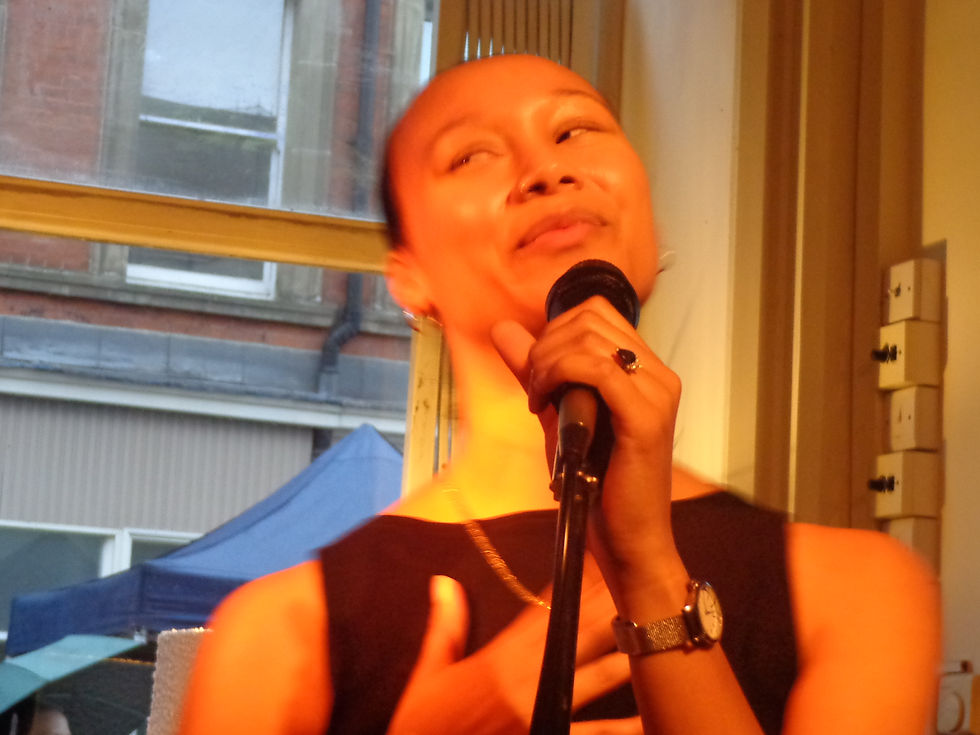
A: I think not everyone can take the risk. But if you can take the risk, just go for it. Because you'll figure it out, but you'll regret not going for it. And so you'll never regret having failed at something in 10 years' time, but you will regret not doing it at all.
Q: Sound advice. What's the type of direction you're thinking of going in? Are you interested in particular genres?
Yeah. I think a person who's probably got a similar career trajectory to what I would love is someone like Leanne Le Havre. You know, she's not necessarily gone down the super commercial route. She's got such a strong fan base. I love her music. People will show up to her gigs, they'll invest in her, and they care about her story. And so I'd love to build a career like that. It's maybe a little bit under the radar, a bit low key, but she's sold out. There's still people there for her. And so I really want to build my community, find my people, and we run together.
Q: What is your opinion on building that fan base and that connection sort of like it's familiar rather than commercial based?
A: I think in one sense, it's really helpful because when you're in a corporate setting, especially in book publishing, you do learn how you monetize art, what that takes. It takes a marketing team, a publicity team, a brand strategy, and momentum. You learn all of these like jargon-y things, which have really helped me when I have my business hat on. But then it also means that when I come to my gigs, I do just love having a conversation with the audience. I always want it to be that personal thing, like whether it's 100 people in the room, 10,000 people in the room, I want to feel like I can share my story. It's a shared moment.
Q: When you're choosing which demos are going to make the cut or how to edit it, do you look at it from an entrepreneurial mindset or whether it is artistically fulfilling?

A: It's a good question and I think there has to be a bit of both because I think ultimately I want to feel like I'm proud of the song and that the song is good. And I try not to think too much about is this going to work for radio? Are the streamers going to like this? Because if you compromise and you make something that you don't love so much and it doesn't do well, then it's lose-lose. You've got no recognition and you hate the song as well. I think often the two will coalesce. Like if something is really vulnerable, honest, interesting, I think people will pay attention to that and they'll respond to that. Maybe it's not like radio one, maybe it's not Spotify, but like there'll be someone that appreciates that.
LYDA was one of the warmest artists we had the chance to speak to. She was inspiring and guiding, whilst always holding that spine of honesty that is integral to conversations about entering the arts. It is always gratifying to meet an artist who is both passionate about their work, but more passionate about its place in the world.
As we stepped back into the rain, we decided it was time for something grittier. So, we headed off to BrewDog.
AV Sunset Band, BrewDog:

BrewDog was filled to the brim and, for a moment, the stage had disappeared into the sea of heads all facing the strobe. As we walked in, the band was gearing up for their next song, and we had no idea what was in store. It became intensely grey outside, with our greatest source of light being the flashing LEDs on the stage. The band kicked off with their sharp guitars, playing an additive rock melody. Their performance style, wordless, was one of the most gripping I had seen all day. The band shredded their guitars and lost themselves in the bridges, headbanging at each strum. The crowd was tense, all waiting for the culmination – and we thought it had concluded. As their final song faded, we began to clap and cheer, only for them to spring into a medley that had been more intense than anything thus far. It was loud, it was disruptive, it was cathartic. I was utterly amazed at how a genre I expected to have overlooked, gripped my attention entirely. I went home and immediately added Empty Vessels and Hasselhoff to my playlists.
By the time we exited BrewDog, it was getting dark, we needed a pub and snack break – a recuperation for the next performance.
Hypnotic Moon People, The Model Nottingham:

Full and tipsy, it felt transcendental entering The Model that evening. A coy percussion echoed to the front, and we found ourselves drawn to the sight at the back. Behind a curtain, almost a cave in the wall, people swayed side to side. All evening, it was the freest dancing I had seen. People hopped around, their scarves moving like liquid, their cheekbones pained from smiling. Hypnotic Moon People energised the audience with their meticulous tapping. The music was quaint, a total juxtaposition from the strumming of Empty Vessels, but it was certainly intentional. Each turn, beat drop, and transition held the crowd’s attention. For however long it was that we were there – because I confess I forgot time existed for a moment – I delicately stomped my feet and felt the energy from the crowd wash over me.
We exited the cave of hypnosis, and headed to our long-awaited destination: Das Kino.
Queerish/Vibrations, Das Kino:
Das Kino was lit to the brim with pink strobes, a space that felt straight out of New York in the 1980s. The culture was poignant, and the intention was clear. This was a safe space for the LGBTQ+ community. We enjoyed our cocktails, and watched the ballroom showcase unfold before us. From sultry struts to mechanical motions – the ballroom showcase remains the highlight of the evening.
The host was captivating. She held the audience’s attention, whilst always diverting attention to the performers. I must also mention the three iconic judges who fluctuated between a gentle click to climbing on the tables to showcase their applause. Overall, it was enthralling. Every single person felt seen. Every single person felt welcomed. I cannot express how grateful and proud I am to have had the opportunity to speak with the presenter and DJs from Vibrations, alongside Queerish (the event’s organiser).
My committe member, Ben Dale, introduced the scene with the organisers. Following the inital introduction, I wanted to get to the honest conversations. The truth behind queer spaces:
Q: There is a struggle within the queer community, because the identity has become monetizable. How can we differentiate between when it's just commercial versus when it's actual genuine activism?
A (Organiser): If you're doing a queer event, it should be made and run by queer people. If you're going to be a corporation in Nottingham it's clear when you're trying to traffic off the queer community. You can't just hire a drag queen or two, or just play some Charli xcx and call it a night. The whole vibe becomes just straight and white. It needs to be open to everyone and let queer people do stuff for cheaper prices because we are a minority. Like we will put an amazing event on like today, but you need to give us the opportunity because we don't have the money. We're marginalized.
A (DJ): Yeah, exactly. Also as well, especially big businesses love to cash in on pink pound, especially at Pride. As a DJ, I get lots of bookings for Pride, but then no one's interested the rest of the year. I am more than just Pride. We are more than just Pride.
Q: We write for students and there's probably so many queer students looking for a safe space. Touch on that.
A (DJ): As for our collective, we have literally just started. We are two DJs and an MC. We're obviously all queer. We have also DJed for Queerish, which we love. But, we want the different side of alternative music. So we're like house, disco, jungle, garage. Queers also love a good boogie! So that's what we started.
A (DJ): They've literally just started House of Pop at Secret Vault. That's going to be a new queer night that's starting next Friday. Vibrations are taking over, which I was very glad about because the people that run it are very straight. And they are paying us well. So I'm happy about that because I'm like, I am worth the money. We are worth the money.
[a roar of laughter and applause breaks out]
Just to add on that, a lot of the gay scenes are aimed at white men. We don't have a space, that's why obviously us being like two women of colour and whatever you are. Yes, we have our token white [points to her bandmate as the group erupts into a giggle] but it's fine because she is the biggest junglist so we'll let her off. We obviously wanted these spaces and that's why we wanted to do it because we're like well where's our representation? We can't have it, so let's make it.
UFO Orchestra & Davina Songbird, St. Mary Church:

As we stepped back outside into the pouring rain, the night could not have taken a more different turn as we headed to St. Mary’s Church. The line was trailing out onto the street as everyone awaited the UFO Orchestra. The church was otherwordly. The way it was lit up with the crowd elucidated an intersection of modernity and tradition. An archaic, gothic architecture encaptured the crowd, as we sat eagerly waiting for the orchestra to kick off. It began, timidly. Throughout each performance, I could not draw my attention away from the conductor. His movements were authoritative and controlled. Each step, each crescendo, each note hung in his hands – and you could see how aware he was of that fact. From the echoes of the solo violinist, or the tremble from the trumpeter – the orchestra was certainly an unmissable performance.
Performing alongside them was the returning and talented vocalist, Davina Songbird. Songbird sang her hit I’m Worthy. With a deep and coated voice. She echoed throughout the church and empowered the audience. The orchestra aided her performance, gracefully, enabling Songbird to riff and belt the important vulnerability in the song.
Jah Digga, Aziza Jaye, K.O.G & Origin One, Broadway Stage:
The day was long gone as we ended up back at square one, Broadway Cinema. Crowds were bursting out of the seams of the room, as a fervent voice carried right through to the entrance. Jah Digga stood on the stage delivering an emboldened speech about cultural disaprities. He spoke a diatribe against the culture of poshness, of exclusivity. He outlined his struggles growing up, and implored the audience to reject any notion of separation. After the sturdy introduction, he began performing. Addictions detailed the struggle of escapism when the world becomes too much to bear. He speaks about substance and sexuality. About masculinity and vulnerability. Overall, he delivered a piercing performance – with a skillful knack for writing.
Following Jah Digga, the prolific K.O.G was joined on stage by the genre-defying Aziza Jaye and thrilling Origin One. This trio is certainly dynamic, bringing a balance of groundedness and excitement. From the first beat drop, the crowd was not merely dancing, but jumping.
The trio had us wrapped around their fingers, and we followed every single instruction. K.O.G occasionally blew his whistle, alerting us to pay close attention to the direction of the next song (though you could never accurately predict it). This was certainly a performance of spontaneity. They managed to take hours of practice translate into an organic moment. I have to note, Aziza Jaye was the standout for me, undoubtedly. She has a way of connecting with the crowd that is nothing short of expert. If you are seeking a sanguine and melodic artist, her songs: Born With It, Touch Road and Blessed have become favourites of mine.
The Afterparties, Baa Bar & Lost Again:
Baffled that I had made it to midnight, I was not going to miss House of Life. We pushed the metallic and large door of Baa Bar open to enter a steamed up, parallel world. On stage, stood a towering 'RaveRend' in a pink priest outfit with a bedazzled beard. The chatter was loud at the bar, but they never failed to attract all of the attention. We were prompted to close our eyes, tap our foreheads and enter a meditative state. As we opened our eyes, “chicken mother” (aka Trev) greeted us. “Chicken mother” started feeding the 'RaveRend' and the audience stood gobsmacked. I am not sure if it was the fact that there was more mist in the room than oxygen, but the visual was frenzying. This was certainly an unforgettable experience, but we were seeking a more traditional afterparty.
Our last stop of the evening was Lost Again, Nottingham. The club is like a snazzy basement, with a dark dancefloor, and lit pool tables. The dancefloor was packed, every person totally engaged in getting lost in the electronic music. The DJ was blissfully unaware of his impact on the crowd, lost in the turn tables. People chatted at the bar, cackled at the pool tables. Strangers struck up impromptu dances with us. For one last time, we lost ourselves to dancing. We remerged onto the streets of Nottingham and peered around at the neighbourhood which had become our own world for the day. For fifteen hours, we had experienced the convergence of genres, ideas, and movements.
To conclude, as a first-timer, Hockley Hustle opened my eyes to the world of music and performance. I felt engaged, at home, and included. Each space evoked a different sense of profundity for me. Whether it was giggling uncontrollably at the witty judges at Das Kino or being brought to misty eyes by UFO Orchestra – I was left fulfilled.
Daniela Roux
Edited by Daniela Roux
Photos and videos courtesy of Daniela Roux


Comments